
Cost Segregation Study for Apartment Complex – Maximize Tax Savings

Apartment owners generally depreciate most of a residential rental building over 27.5 years. That rental property depreciation schedule is straightforward, but it can delay deductions connected to shorter-lived components. A Cost Segregation Study for an Apartment Complex uses construction and tax analysis to identify qualifying assets, assign appropriate recovery periods, and accelerate depreciation without increasing the total depreciable basis.
Results depend on the purchase date, placed-in-service date, basis, hold period, and investor’s tax profile. Property owners seeking a property-specific estimate can request a no-obligation feasibility review from Cost Segregation Guys before commissioning a full study.
What Is Apartment Cost Segregation?
A cost segregation analysis separates eligible personal property and land improvements from structural building components. A quality report explains its methodology, estimates, and classification support. Land must be excluded from depreciation, while the building basis should be supported by closing records, appraisals, construction documents, or reasonable estimates.
This multifamily cost segregation guide explains how apartment features may be evaluated in an engineering-based study.
How Accelerated Depreciation Works
IRS guidance for residential rental property places apartment buildings and structural components in a 27.5-year recovery period. Appliances, carpeting, and certain furniture may have five-year lives, while roads, shrubbery, and fences may have 15-year lives.
Current IRS depreciation rules state that certain qualified MACRS property with a recovery period of 20 years or less, acquired and placed in service after January 19, 2025, generally receives 100% bonus depreciation, also called the special depreciation allowance, unless the taxpayer elects otherwise or an exception applies. Different rules may apply to earlier acquisitions.
Apartment Components Commonly Reviewed
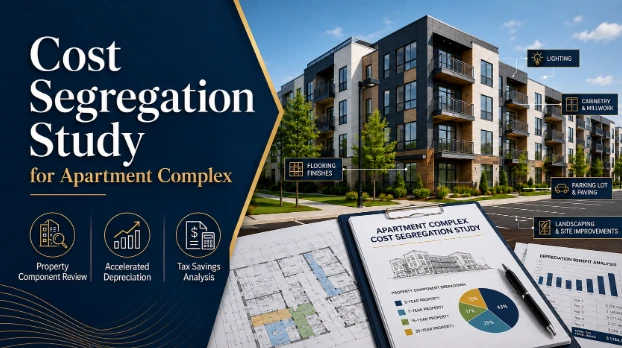
- Carpeting, appliances, removable window treatments, and certain decorative finishes
- Parking areas, fencing, landscaping, site lighting, and qualifying site utilities
- Furniture, laundry equipment, signage, security equipment, and qualifying office assets
Classification depends on each asset’s function and tax authority, not simply its name or location.
A Simplified Apartment Building Cost Segregation Example
Assume an apartment property has a $4 million depreciable building basis after the land value is removed. Without cost segregation, a full year of straight-line depreciation would be approximately $145,455 before applying the mid-month convention.
Now, assume a Cost Segregation Study for Apartment Complex assets identifies 30% to 35% of the depreciable basis as qualifying five-year, seven-year, or 15-year property. In this example, approximately $1.2 million to $1.4 million would be reclassified into shorter recovery periods.
If those assets qualify for the 100% special depreciation allowance, the property owner could potentially deduct up to $1.2 million to $1.4 million in the first year. The remaining $2.6 million to $2.8 million of building basis would generally continue to be depreciated over 27.5 years, with an additional first-year deduction determined by the property’s placed-in-service date and the mid-month convention.
The actual allocation and tax benefits depend on the apartment complex’s construction components, supporting records, placed-in-service date, applicable tax law, passive activity rules, at-risk limitations, and the owner’s individual tax position.
When Does a Study Make Financial Sense?
Apartment cost segregation is often most compelling when:
- The property has a meaningful depreciable basis after land allocation
- The owner can currently use accelerated depreciation deductions
- Reliable purchase, renovation, or construction records are available
- The hold period, recapture exposure, fees, and projected tax benefits have been modeled
There is no universal minimum purchase price. A smaller building with extensive improvements may justify a study, while a larger property may not if deductions cannot be used or a sale is imminent.
Can an Existing Apartment Property Still Qualify?
Yes. Owners can often study a property years after it was placed in service. A cost segregation look-back study may identify depreciation that should have been claimed earlier. Instead of amending multiple returns, a taxpayer may be able to request an accounting-method change and recognize a Section 481(a) adjustment in the current year.
The filing is commonly coordinated through Form 3115. Owners can review Cost Segregation Guys’ Form 3115 guide and the official IRS Form 3115 page, but eligibility and procedures should be confirmed by their CPA. For a prior-year purchase, the Apartment Complex assets should reconcile with the existing depreciation schedule.
Essential Due Diligence Before Filing
A defensible report should reconcile basis, separate land, explain classification authority, document estimates, and provide a fixed-asset schedule. Owners should also evaluate state conformity, passive loss limits, and potential recapture. Cost segregation changes the timing of depreciation; it does not automatically make a rental loss deductible against salary or other nonpassive income.
Turn Hidden Building Costs Into a Stronger Tax Plan
A Cost Segregation Study can be a powerful real estate tax strategy when engineering detail and tax planning work together. It can improve near-term cash flow, but the benefit must align with the investor’s income, holding period, and exit plan. To evaluate multifamily tax savings using the property’s actual basis and placed-in-service date, you can contact experts like Cost Segregation Guys for a free proposal and review the findings with a qualified tax advisor.








 Accessibility