
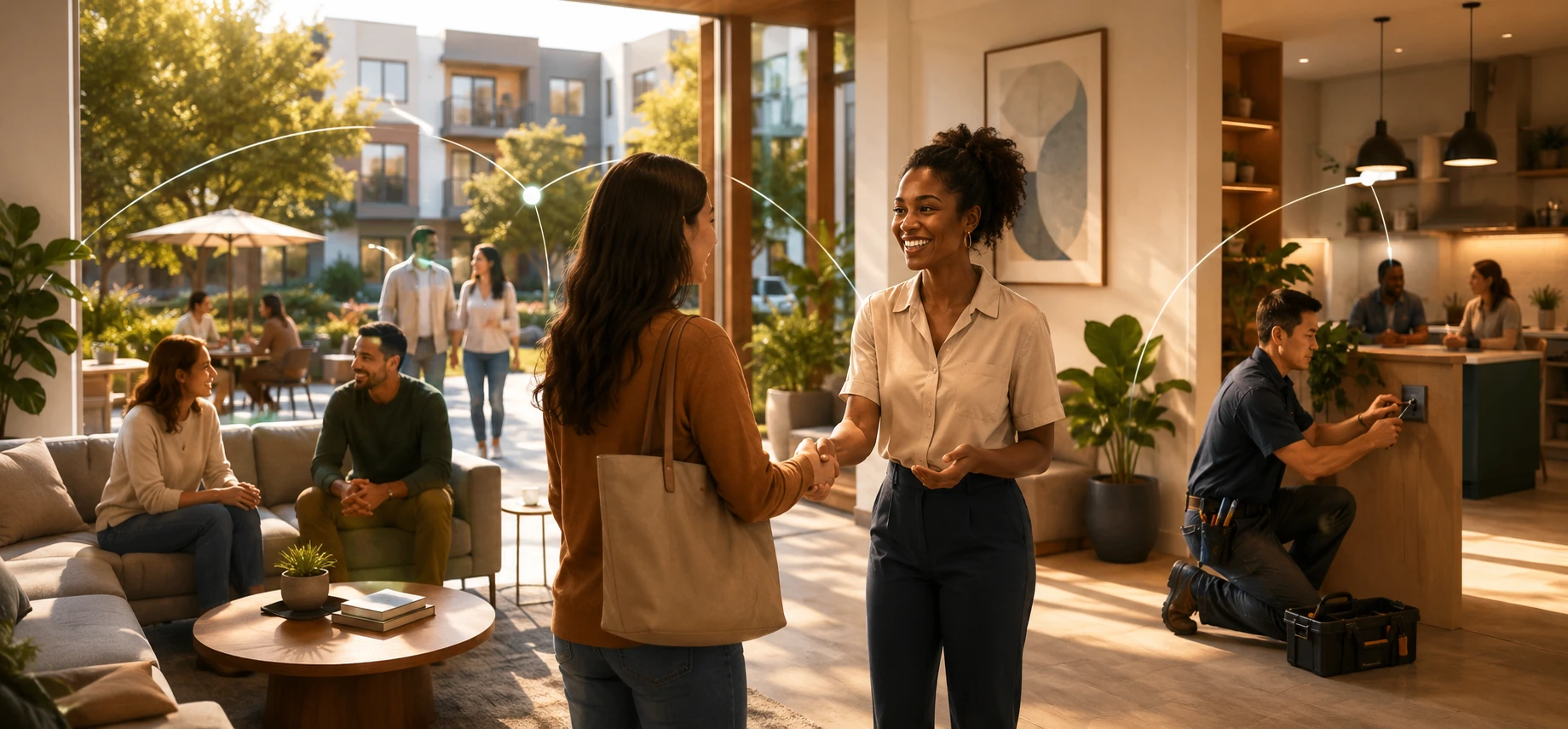
What Property Management Can Learn From the Hospitality Industry

We tell residents they should feel at home in their community. We tell employees they’re a core part of that community. But do our day-to-day operations actually make either group feel seen, heard, or valued?
It’s no secret that the landlord-tenant relationship has historically carried an adversarial tension. Landlords protect their property; tenants protect the place they call home, and those interests have not always felt aligned. That rift can exist in both residential and commercial property relationships.
But what if a better relationship model could help create the sense of community we are all seeking? What if hospitality offers a way out of that inherited adversarial frame?
What if we thought of a community as a social network in the most literal sense as in a network of owners, residents, employees and partners, each invested in the same place in different ways? What could change if each party understood that protecting its own interests did not require disregarding the interests of the other?
Hospitality as an Operating Philosophy
Property management often borrows the language of hospitality without fully adopting the operating discipline behind it. And when the employee experience contradicts the resident-facing promise, hospitality becomes performance rather than culture.
Property management should take a page out of the hospitality industry’s playbook. Hospitality is not an amenity package. It is an operating philosophy. Property management keeps communities clean, functional, welcoming, and worth calling home over the long term. Make hospitality the operating discipline and it could be the game-changer!
Hospitality is not just “Welcome Home!” signs, resident events, branded coffee stations, and a friendly leasing office. At its best, hospitality means deliberately designing the experience around the person receiving it: noticing friction, anticipating needs, recovering when something goes wrong, communicating before the customer has to chase you, and understanding that every operational interaction contributes to whether someone feels valued.
Listening Beyond the Metrics
It is the goal of the property management companies to keep their “fingers on the pulse” of their communities health and well-being. When managers are collecting data through surveys, retention numbers, complaint logs, work-order close rates, renewal percentages, are they hearing the community?
Those are useful indicators, but they are not the same as understanding why residents stay, disengage, complain, or stop voicing their observations if and when they weren’t heard the first time. If that’s where it becomes important to refocus on the resident experience, therein lies the connection back to bringing hospitality into the mix. Metrics show what happened, listening can say why.
Resident Retention
Do people renew because they feel connected and cared for, or because moving is expensive and inconvenient? That is a tough question because both can be true in our current economy. We need the community and their voices to truly know the value of the pulse we, as resident representatives, need to stay on track for the benefit of everyone.
Employee Retention
Employee experience affects whether the resident promise can actually be delivered. Do employees stay because the culture works, or because they haven’t found the exit yet? I have personally seen employees in property management looking for the exit while an organization was still outwardly expected to project stability, welcome, and community.
In a hospitality environment, the guest experience is constantly treated as an operational necessity. You get complimentary food and beverage items. You get the gracious hellos and goodbyes, and, thank you for choosing us knowing you have other options.
In residential property management, people can sometimes talk about “community” as though the word itself creates one. In order to have a community, you have to believe in it as if it were your own and how you want it to look on a daily basis. Do we understand how residents experience the people serving them and how employees experience the community they serve?
The gap between what an organization says it values and what its operations actually produce feels large. Like IMAX large.
Measuring Belonging, Not Just Activity
It’s easy to mistake occupancy, renewal rates, and closed work orders for proof that a community feels cared for. They measure activity. They don’t always measure belonging.
The uncomfortable questions have value. As an industry, are we listening before residents leave? Are we noticing when employees disengage? Are we creating community or merely administering property?
Property management can get trapped in a different orientation: Is the unit occupied? Was rent collected? Was the work order closed? Was the violation processed? Did the resident renew? Those measurements matter—but they can create the illusion that you have your hand on the community’s pulse when you’re really measuring its vital statistics.
A resident can renew and still be unhappy.
An employee can stay and still be disengaged.
A work order can be closed and still leave a resident feeling ignored.
A community can be fully occupied without feeling remotely like home.
The Employee Experience Becomes the Resident Experience
The employee experience becomes the resident experience. You cannot sustainably ask burned-out, unheard, poorly supported employees to manufacture warmth and belonging for residents. Hospitality has to travel through the organization before it can reach the front door.
You can train an employee to smile, use someone’s name, answer the phone warmly, host a resident event, or say Welcome home. But if that employee feels ignored, overloaded, unsupported, or disposable, eventually the hospitality becomes performance rather than culture. People can feel the difference.
Hospitality cannot be manufactured at the front line if it is absent behind the scenes. Genuineness isn’t about demanding that employees be endlessly cheerful or emotionally available. It comes from building conditions in which the behavior you want from them is actually believable.








 Accessibility