
The Best Markets For Investing In Single-Family Homes Right Now

It’s clear that the housing market has heated up, with a lack of inventory for sale pushing up prices and making conditions tough for would-be home buyers. But as we’ve said previously, it’s a great time to be a landlord. Specifically, in Genesee County, which encompasses Flint, Mich.
The county that includes Flint, of all places, tops the list of single-family home growth markets identified by RealtyTrac, an Irvine, Calif.-based housing data firm. How could a place with a lead-tainted water supply possibly be a good rental market? It’s really just a case of pure math.
RealtyTrac screened for counties that had wage growth of at least 5%–more than twice the nation’s current average–and then ranked the cities on their annual return. In Genessee County, home sales prices are low, while rents remain relatively high, thanks in part to government subsidies for rents. During the first quarter of this year, the median home sales price in Genessee County was a mere $80,000. A three-bedroom home rents for a median of $1,018, or $12,216 per year. That’s an annual gross rental yield of 15.3%–the highest of the 448 counties RealtyTrac analyzed.
Here’s how the math works: an investor can pay $80,000 for a property and get $12,216 back in the first year. That’s 15.3% of the cost to buy the property, for a pretty quick return. Bear in mind that this is gross return–if you were really investing you’d have to weigh the costs of maintaining the property, as well as property taxes, and the cost of vacancies, or tenants who don’t pay.
Investing in single-family homes, of course, is more than an exercise in math alone. There are other factors to consider: how safe a neighborhood is, what tenants (in terms of income level and stability) it is likely to attract, whether there will be a steady supply of tenants given the local economy and its job opportunities. In the case of Genesee County, the 48505 ZIP in Flint has a median home price of $7,700-but those lower prices might indicate a riskier part of the county.
“There’s going to be higher expenses in certain markets,” says Daren Blomquist, senior vice president of RealtyTrac. “The cost of collecting the rent, that can be tougher in some areas than others. You’re going to have higher delinquency rates in some areas versus others. The cost of vacancy is another big one. And just in general, turnover–some areas have much higher areas than others.”
Typically, around 40% of gross rent will go to expenses, Blomquist says. The basic math of purchase price versus potential income is good place to start to see if an investment might make sense.
Below are a few graphics RealtyTrac released today that you can use to quickly scan the data. They’re worth a look, not only for would-be investors, but for renters and home buyers as well. The data for each county could even be helpful for job-searchers–given the housing costs, maybe an offer in Cleveland will start looking better than one in Seattle.
In the first map, below, you can scroll through 448 U.S. counties and see median sales prices for single-family homes, as well as median rents, and the resulting annual yield you could expect if you bought today. Wage growth is also shown.
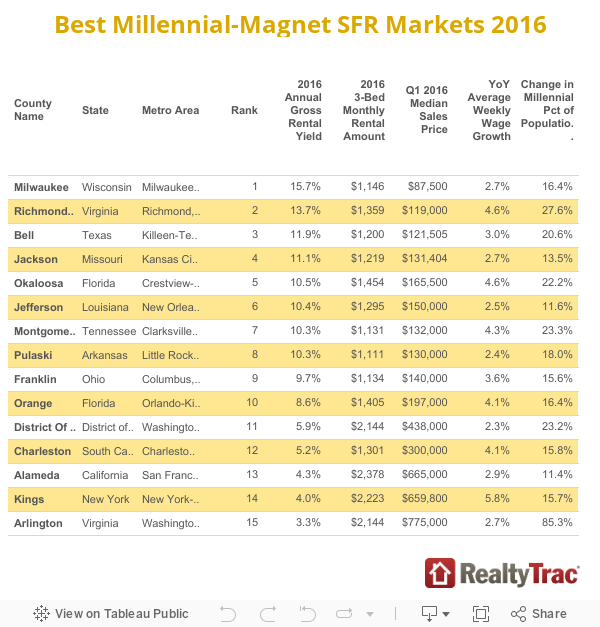
Finally, below is a list of the 15 best counties for investing in single-family homes ranked by their rate of attracting a growing Millennial population. That generation has now surpassed other generations as the largest group in the workforce.
Source: forbes.com






 Accessibility