
The 60-Second Luxury Audit

What Prospects Notice Before Anyone Says Hello

Luxury is being judged before your leasing professional ever gets the chance to explain it.
A prospect pulls into your property.
She is not carrying a clipboard.
She is not consciously assigning points for signage, lighting, cleanliness, parking, scent or wayfinding.
But she is evaluating all of it.
Within seconds, she is answering questions she may never say out loud:
- Does this place feel cared for?
- Does it feel easy to navigate?
- Does the experience match what I saw online?
- Do I feel expected?
- Does this feel worth the rent?
- And perhaps most importantly:
- Does this feel like the kind of place where details matter?
That entire assessment can happen before anyone in the leasing office says a word.
This is one of the reasons luxury apartment marketing cannot stop at advertising, photography or the model unit.
The prospect is not experiencing the brand in sections.
She is experiencing one continuous story.
And the first 60 seconds of that story can either reinforce your premium positioning or begin quietly dismantling it.
Luxury Has a Pre-Tour
In multifamily, we often think of the tour as the moment when the sales experience begins.
It does not.
The tour has a pre-tour.
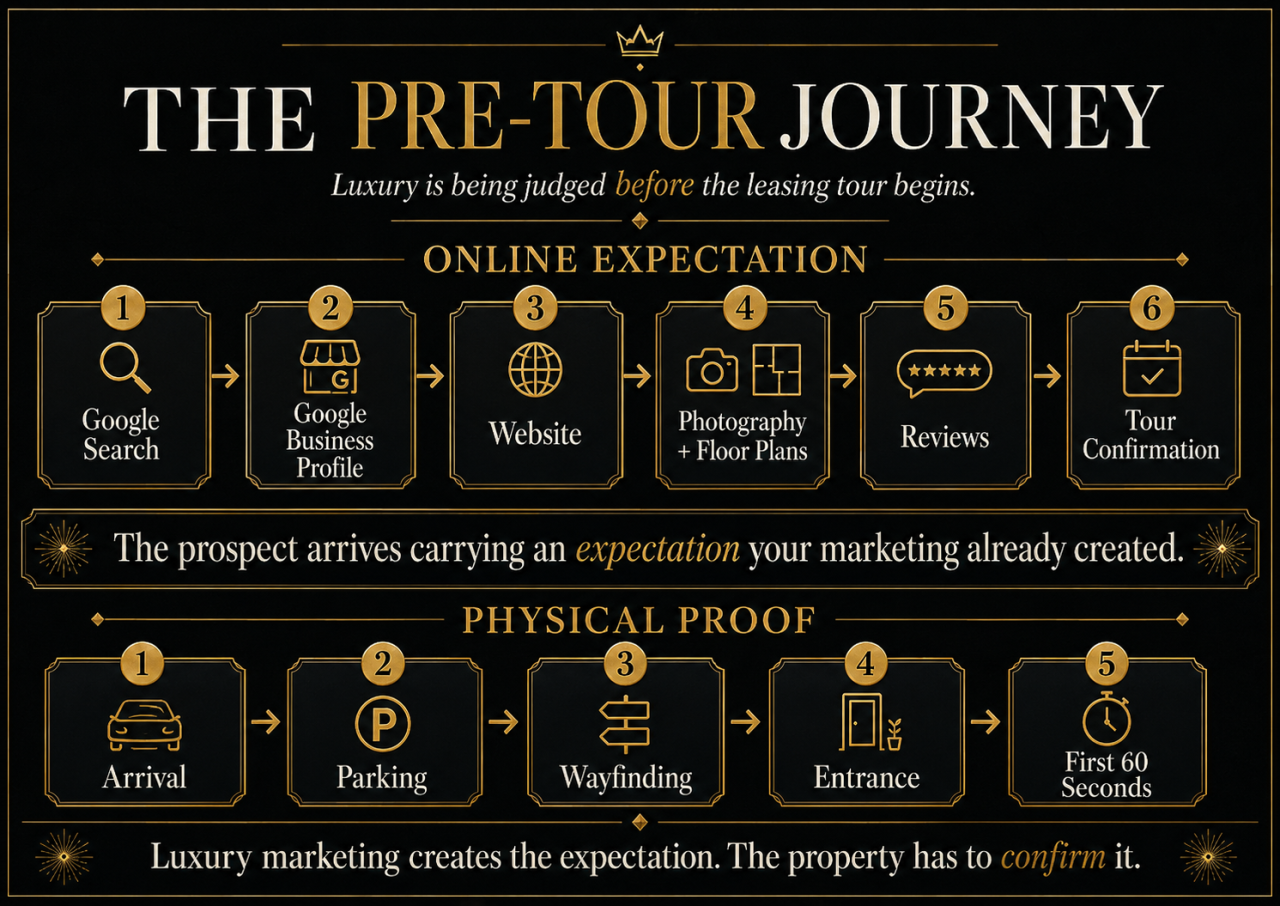
The prospect has already seen your Google listing.
She has probably looked through your photography.
She may have read reviews.
She has visited your website.
She may have compared your pricing with three or four competitors.
She has formed an expectation.
Then she arrives.
That transition from digital promise to physical proof is one of the most important moments in luxury apartment marketing.
If the online experience says polished, intuitive and elevated, but arrival feels confusing, cluttered or ordinary, the prospect notices the contradiction immediately.
That is why I use what I call the 60-Second Luxury Audit.
It is a simple test:
Walk the first minute of the prospect experience without explaining anything.
No leasing pitch.
No benefit statements.
No “our residents love this.”
No excuses.
Just observe what the environment communicates on its own.
Because before your leasing team gets the opportunity to tell the luxury story, the property has already started telling one.
Report Your Tenant’s Rent Today!
Report on-time & missed payments to Experian, Equifax, and TransUnion
Before the Clock Starts: The Expectation You Created Online
Technically, the first impression happened before the prospect arrived.
Your digital presence established the benchmark she will use to judge the property.
Look at your:
- Google Business Profile
- Website
- Apartment photography
- Floor plans
- Social content
- Reviews
- Paid advertising
- Tour confirmation
- Arrival instructions
Now ask one question:
What expectation did we just create?
If your photography is dramatic, your copy is refined and your brand promises effortless living, the prospect is arriving with a premium expectation.
That is good.
But premium expectations come with a higher burden of proof.
The stronger your marketing is, the more noticeable the disconnect becomes when the property experience fails to support it.
You cannot market at one standard and operate at another without eventually creating friction.
Now start the clock.
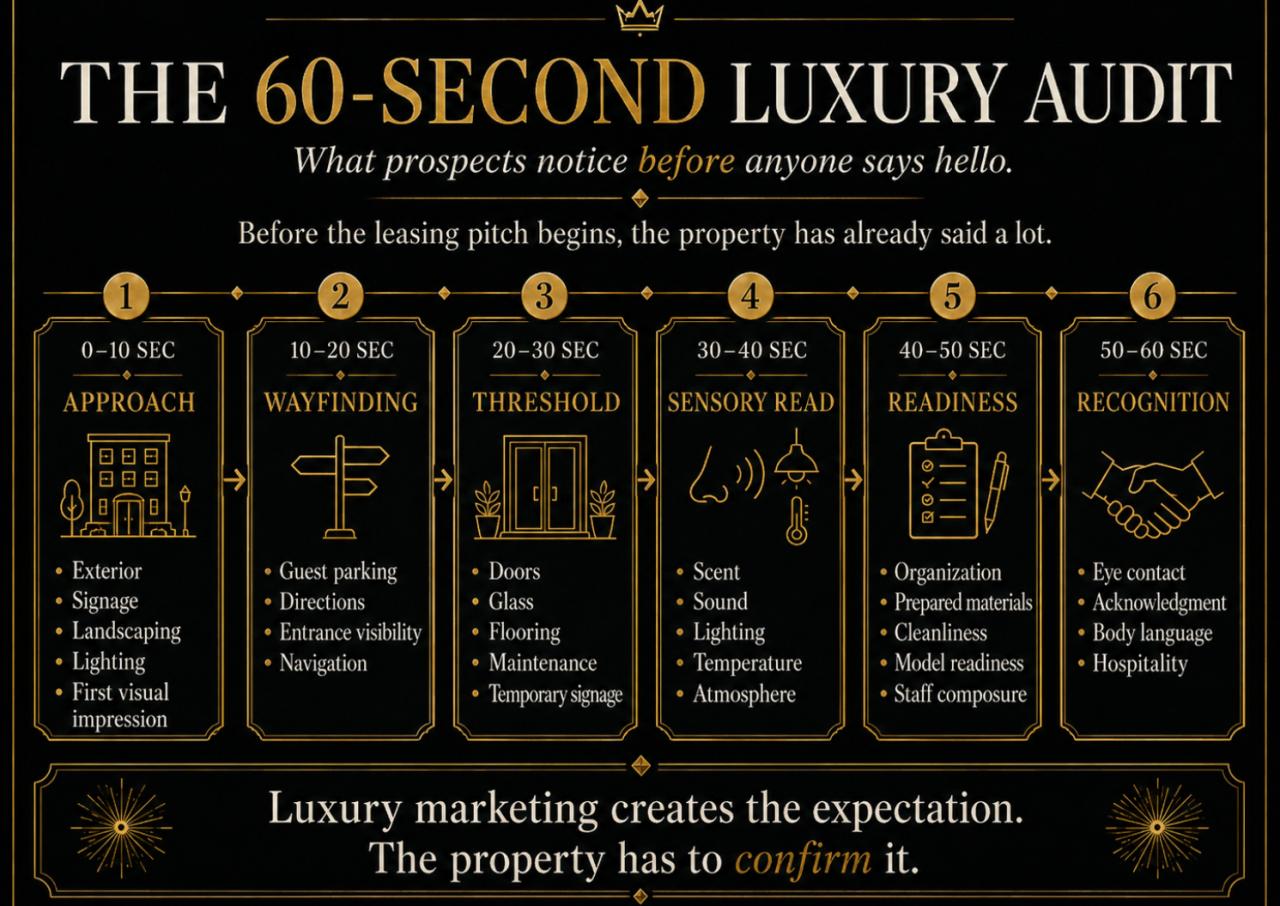
The 60-Second Luxury Audit
0–10 Seconds: The Approach
The prospect is looking for confirmation.
Not consciously, perhaps, but visually.
What does she see as she approaches the community?
Signage?
Landscaping?
The condition of the exterior?
Construction debris?
Trash?
Lighting?
Cars?
Package deliveries?
A clear entrance?
A mystery entrance?
At this point, the prospect has not yet experienced your amenities.
She has experienced your standards.
That distinction matters.
A property does not have to look brand new to feel premium.
But it must look intentionally managed.
Luxury is often less about whether something is expensive and more about whether something appears neglected.
A beautiful building with an overflowing trash can near the entrance sends two conflicting signals.
A premium monument sign surrounded by poorly maintained landscaping does the same.
The prospect may not remember exactly what bothered her.
She may simply remember that something felt off.
Audit question:
If a prospect photographed the first thing she saw upon arrival, would you want that image included in your marketing?
10–20 Seconds: Parking and Wayfinding
Now the prospect needs to know where to go.
This is where luxury frequently encounters unnecessary friction.
Where should she park?
Is guest parking clearly marked?
Is the leasing entrance obvious?
Did the confirmation email tell her where to go?
Does she need to circle the building?
Is she standing in a garage trying to determine which elevator leads to the leasing office?
Does she have to call and ask?
Every moment of uncertainty creates cognitive friction.
And luxury should reduce friction, not manufacture it.
Wayfinding may sound like an operational detail.
It is actually part of brand experience.
A premium community should make the prospect feel guided.
Not managed.
Not confused.
Guided.
The best arrival experiences almost feel invisible because the prospect never has to stop and wonder what happens next.
Audit question:
Could someone who has never visited your property successfully find the leasing office without calling for help?
20–30 Seconds: The Threshold
The entrance is one of the most psychologically important moments in the prospect journey.
Crossing the threshold is when the prospect moves from imagining the property to physically experiencing it.
Look at the entrance with fresh eyes.
Glass doors.
Door handles.
Floor mats.
Lighting.
Walls.
Windows.
Entry systems.
Furniture.
Signage.
Packages.
Maintenance equipment.
Temporary notices.
The details closest to the entrance deserve disproportionate attention because they are disproportionately likely to be noticed.
And yet those are often the details onsite teams stop seeing.
That is a recurring operational problem.
When you walk through the same entrance every day, visual imperfections gradually become invisible.
The prospect does not have that luxury.
She sees the property for the first time.
Audit question:
What has your team stopped noticing because they see it every day?
That may be one of the most valuable questions in this entire audit.
30–40 Seconds: The Sensory Read
By now, the prospect is no longer simply looking.
She is experiencing.
What does the space smell like?
What does it sound like?
What is the temperature?
How bright is the room?
Does the space feel calm?
Does it feel chaotic?
Does the scent feel intentional or overpowering?
Is music appropriate to the environment?
Can she hear staff conversations that were never meant to become part of the customer experience?
Luxury is multisensory.
That does not mean every luxury community needs a signature fragrance and curated playlist.
It means the sensory environment should support the positioning rather than contradict it.
Imagine beautiful photography selling a peaceful, elevated community.
Then imagine arriving to harsh fluorescent lighting, loud televisions and an overwhelming air freshener.
Technically, none of those things are catastrophic.
Collectively, they change the experience.
Premium perception is often built through accumulation.
So is disappointment.
Audit question:
If you closed your eyes inside your leasing environment, would the sounds and scents still communicate the brand you are trying to sell?
40–50 Seconds: Visible Readiness
Now the prospect begins looking for signs that the organization behind the property is prepared.
Is the reception area clean?
Are desks organized?
Are leasing materials ready?
Is the lobby filled with boxes?
Are staff members scrambling?
Are yesterday’s refreshments still sitting out?
Are there handwritten signs that should have been professionally produced?
Is the model key missing?
Is anyone visibly expecting an appointment?
Operational readiness is one of the strongest luxury signals because it communicates competence.
The prospect does not need to know everything happening behind the scenes.
In fact, premium service often depends on her not seeing the behind-the-scenes complexity.
Luxury should feel composed.
That does not mean teams cannot be busy.
It means the customer experience should not feel like a casualty of that busyness.
Audit question:
Does the leasing environment look prepared for a prospect or interrupted by one?
There is a major difference.
50–60 Seconds: Recognition
Before anyone says hello, another powerful signal appears:
Does anyone notice her?
Eye contact matters.
Body language matters.
Acknowledgment matters.
A leasing professional finishing another conversation may not be able to immediately assist her.
That is fine.
Being temporarily unavailable is different from making someone feel invisible.
Luxury service is not always about speed.
It is about recognition.
A glance.
A smile.
A gesture that communicates, “I see you.”
That tiny moment changes the emotional temperature of the arrival.
The prospect stops feeling like an interruption and starts feeling expected.
This is where luxury moves from environment into hospitality.
Audit question:
How many seconds does a prospect typically stand in your leasing space before someone visibly acknowledges her presence?
Do not guess.
Measure it.
The 60-Second Luxury Audit Scorecard
Score each part of the first minute from 1 to 5.
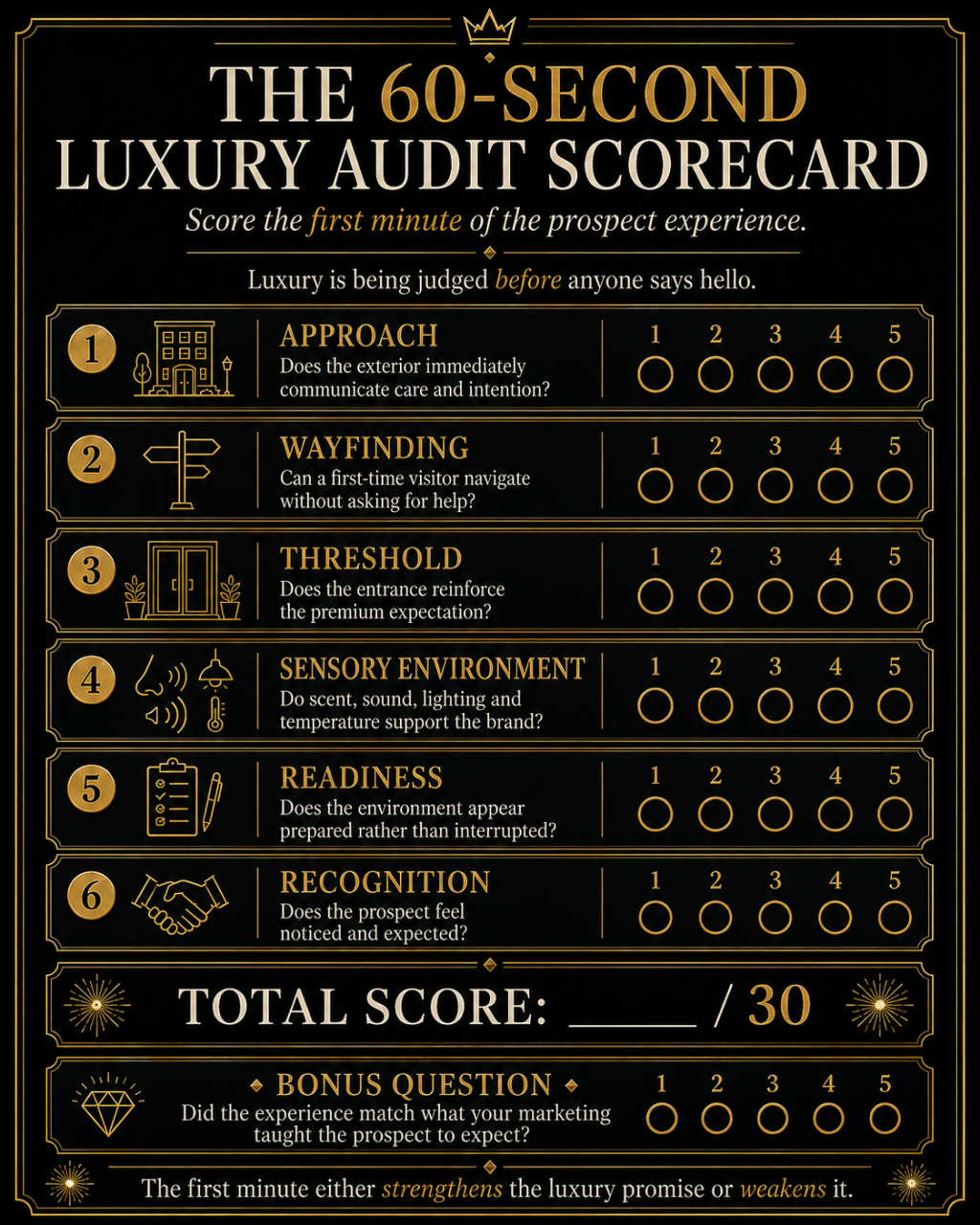
Then add one more question that is not scored:
Did the experience match what our marketing taught the prospect to expect?
That answer may matter more than the total.
The Details That Do Not Make the Brochure
Here is where this gets uncomfortable.
Some of the most important luxury signals will never appear in your marketing materials.
No apartment brochure says:
“Our entrance glass is always spotless.”
“Our leasing professionals notice you immediately.”
“Our guest parking is incredibly easy to understand.”
“Our lobby never smells strange.”
“Our tour confirmation tells you exactly where to go.”
“Our model is actually ready when you arrive.”
They sound almost too basic to market.
And yet when those basics fail, the prospect absolutely notices.
This is one of the paradoxes of luxury marketing:
The details that create the strongest premium perception are often the details no one thinks to advertise.
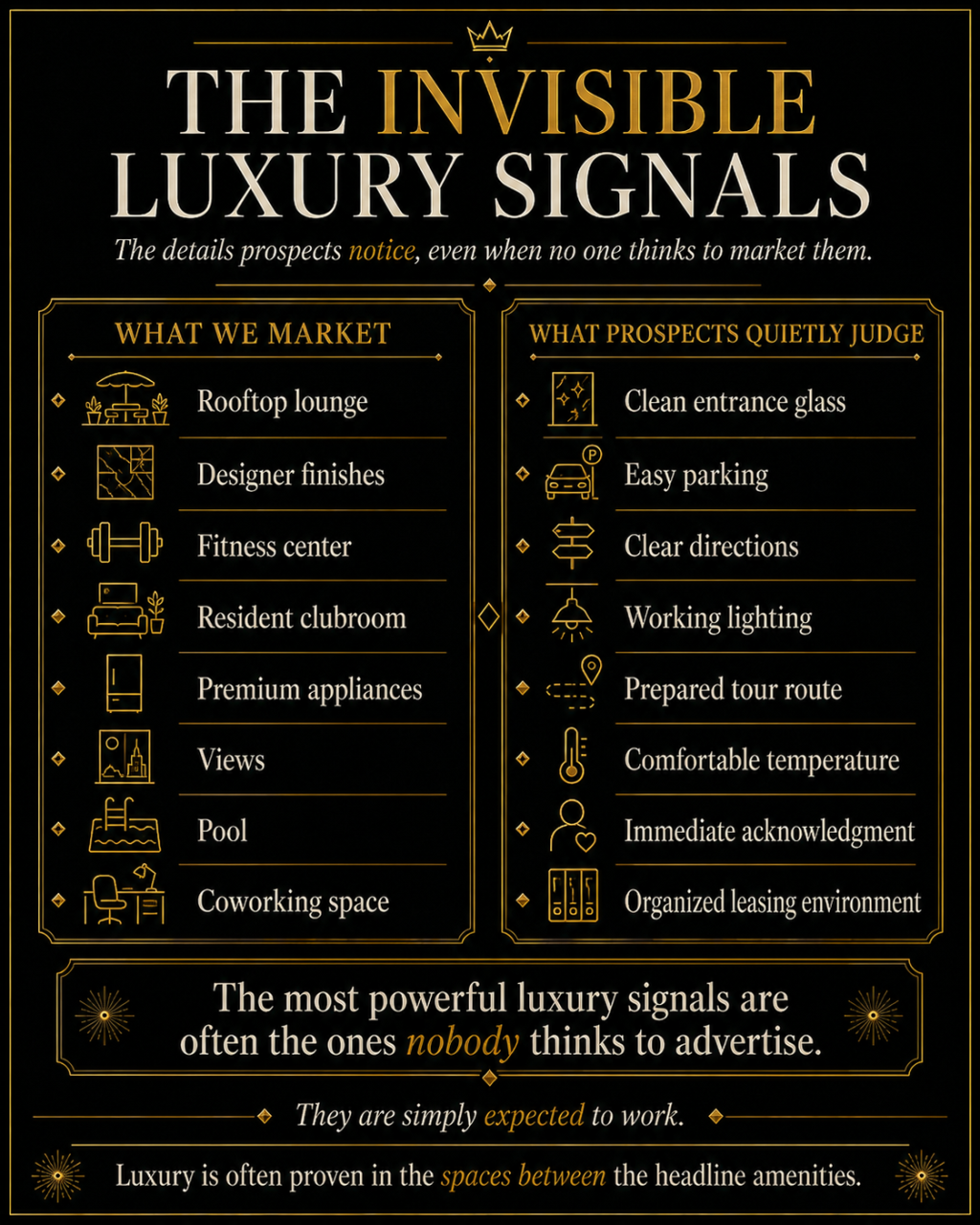
They are simply expected to work.
That is why luxury is so operationally demanding.
The renter is not only evaluating the features you intentionally showcase.
She is evaluating the standards revealed in the spaces between those features.
Stop Trying to Explain Away the Experience
During property walks, it is easy to explain what we see.
“That sign is temporary.”
“Maintenance is fixing that tomorrow.”
“We normally have music playing.”
“The landscaper comes on Thursday.”
“That door is usually unlocked.”
“The model was used for an event yesterday.”
Perhaps every explanation is completely reasonable.
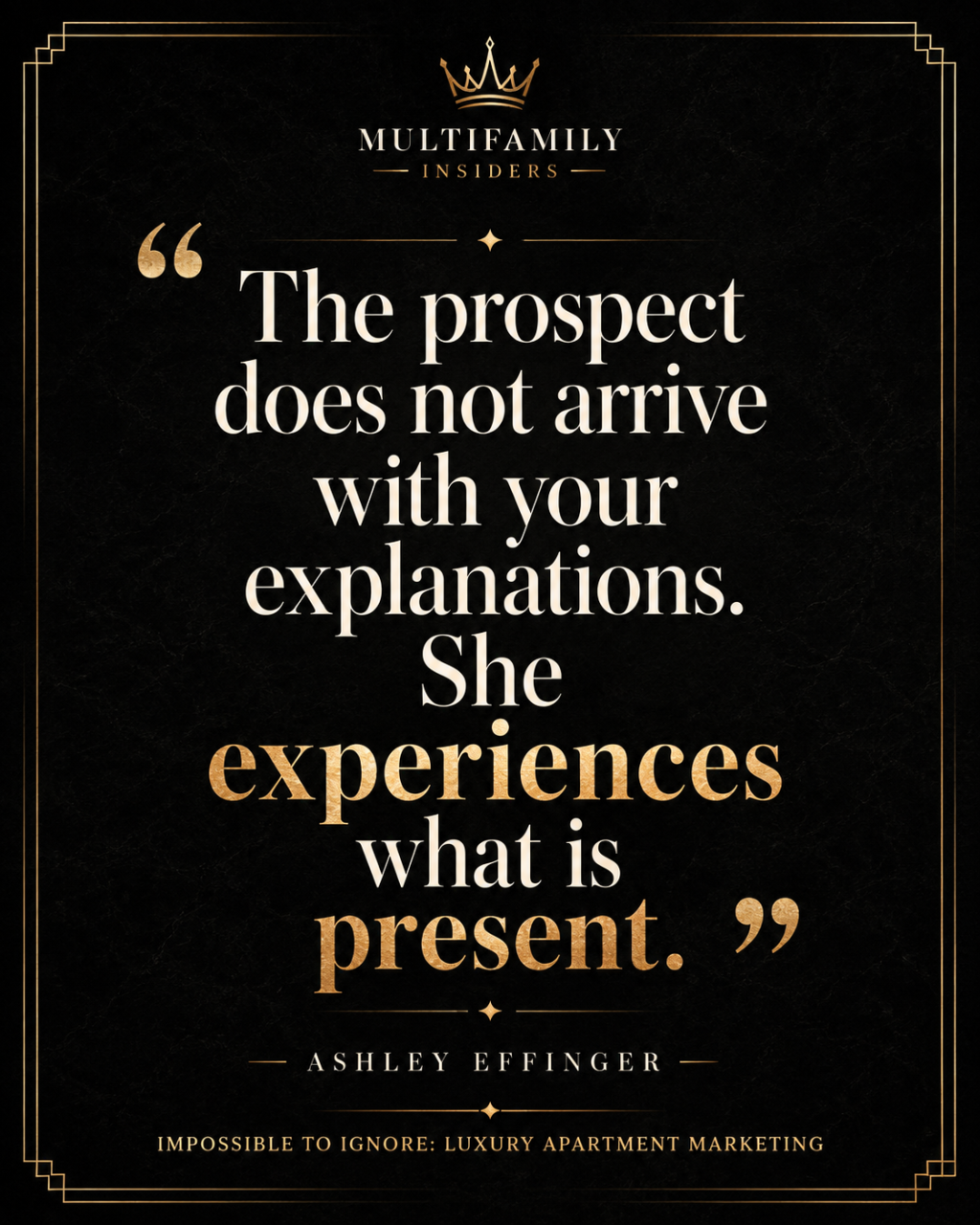
The prospect does not arrive with those explanations.
She experiences what is present.
That is why one of the rules of the 60-Second Luxury Audit is:
No defending the property while you audit it.
If something looks confusing, score the confusion.
If something feels neglected, score the neglect.
If the arrival instructions are unclear, score the friction.
You can diagnose the reason afterward.
First, experience the reality.
The Marketing Team Should Walk This Too
This audit should not belong exclusively to property management.
Marketing needs to walk it.
Regional leadership needs to walk it.
The leasing team needs to walk it.
Vendor partners who shape the brand may need to walk it.
Why?
Because each team sees something different.
Marketing may notice brand inconsistency.
Operations may notice maintenance.
Leasing may notice workflow.
Leadership may notice standards.
The prospect notices all of it at once.
That is why luxury apartment marketing cannot function as a department sitting somewhere upstream sending traffic toward a property.
Marketing and operations are jointly responsible for whether the promise survives contact with the customer.
What to Do This Week
Choose one community.
Do not announce that you are auditing it.
Do not schedule a special property walk.
Do not ask the team to prepare.
Arrive the way a prospect would.
Use the same directions.
Park in the same location.
Walk through the same entrance.
Start a timer.
For 60 seconds, say nothing.
Observe.
Take notes.
Then score:
Approach.
Wayfinding.
Threshold.
Sensory environment.
Readiness.
Recognition.
Afterward, compare that first minute with the community’s website.
Ask:
Would I believe these two experiences belong to the same brand?
If the answer is no, you have found something far more important than a cosmetic issue.
You have found a break in the luxury promise.
Luxury Begins Before the Welcome
We spend enormous amounts of time developing campaigns, selecting photography, writing headlines, optimizing websites and positioning amenities.
All of that matters.
But eventually, every piece of marketing sends a real person toward a real place.
And that is where the brand has to become physical.
Luxury is not proven when the prospect reads the word on your website.
It is proven when the experience begins behaving like it.
Before the tour.
Before the pitch.
Before the model.
Before anyone says hello.
One Question for the Industry
If your leasing team were not allowed to explain, apologize for or sell anything during a prospect’s first 60 seconds onsite, would the property itself still make a convincing case for luxury?










 Accessibility