
Urgency Needs More Than a Deadline
How to Create Urgency Without Cheapening the Brand

A concession can accelerate a leasing decision. It can also teach the market to wait for the next discount.
That is the tension multifamily marketers are navigating. Occupancy pressure is real. Competitive specials are visible. Revenue goals do not pause while a property waits for its brand story to mature. Yet the fastest message to deploy, such as one month free, reduced deposits or a gift card, can become the only message prospects remember.
The problem is not the concession itself. The problem is allowing a temporary incentive to replace the permanent case for value.
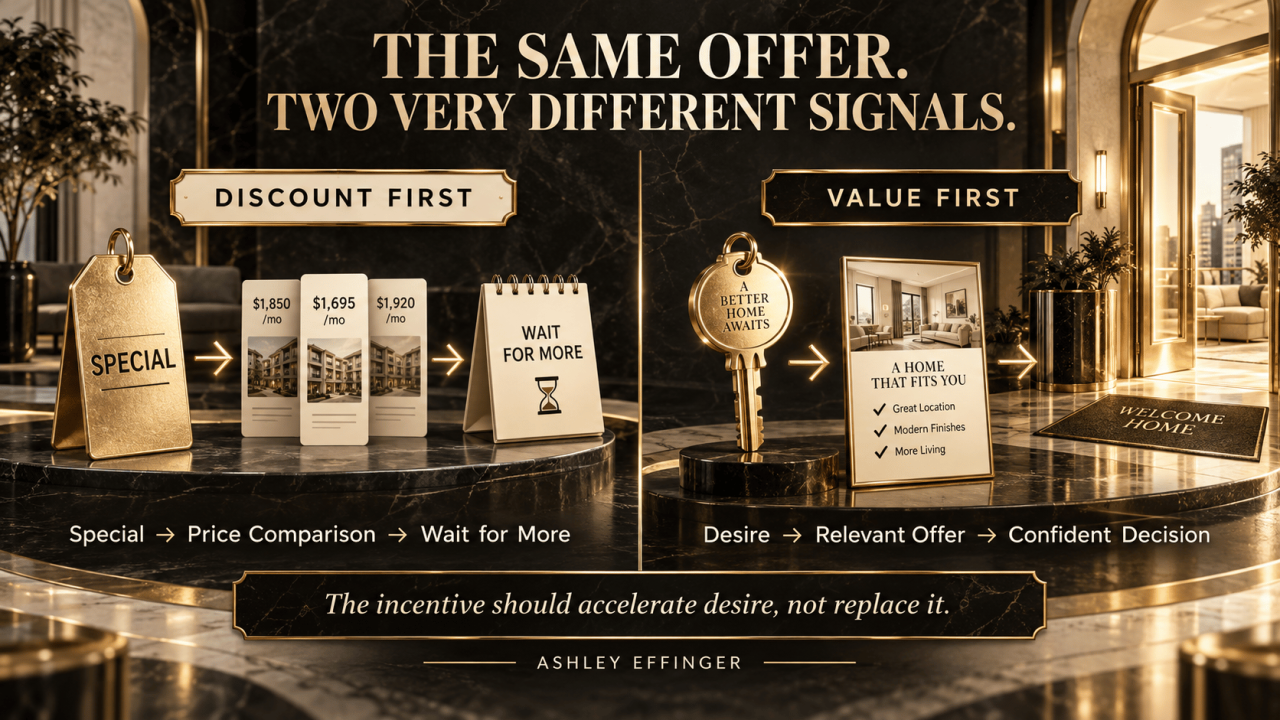
When a campaign leads with the discount and never rebuilds the value around it, the property becomes easier to compare on price alone. When the offer is positioned as a specific, credible advantage attached to a desirable home and experience, it can remove friction without lowering the brand’s perceived worth.
The goal is not to eliminate concessions. It is to stop asking them to do work they were never designed to do.
The Concession Is Not the Strategy
A concession is a financial tool. It can help absorb seasonality, increase velocity for a specific floor plan, support a new lease-up or create movement around near-term availability. It becomes a brand problem when it is used as a substitute for diagnosis.
If tours are weak, follow-up is inconsistent, pricing is misaligned, inventory is poorly merchandised or the experience does not support the promise, a louder special may create activity without fixing the source of the problem. It can produce more clicks, more bargain-led inquiries and a temporary spike in traffic while the same conversion leaks remain underneath.
That is the concession trap: using a temporary discount to compensate for a permanent weakness in demand, differentiation, proof or process.
It is tempting because the special is visible and immediate. The underlying issue is usually less convenient. It may sit in photography, reputation, response time, tour quality, pricing, unit readiness, floor-plan positioning or the gap between what marketing promises and what the prospect experiences.
A concession can create urgency. It cannot create confidence where confidence is missing.
What the Prospect Hears
Marketers often think they are communicating savings. Prospects may be hearing something else:
- This property is struggling to lease.
- The advertised rent is not the real value.
- A better special may appear if I wait.
- Every nearby community is offering the same thing, so I should choose the largest discount.
The more dominant the concession becomes, the more it resets the comparison. Instead of asking, “Which community fits my life best?” the prospect begins asking, “Who is giving me the most?”
That shift matters most for premium communities.
Premium positioning depends on a coherent Proof Stack: the photography, digital journey, reputation, leasing experience, home, amenities and service must reinforce the claim. If the brand says elevated but the campaign says discount first, the Luxury Proof Gap widens before the prospect ever tours.
Luxury is not protected by avoiding every special. It is protected by ensuring the special never becomes the strongest proof the property has.
Urgency Needs More Than a Deadline
A countdown is not automatically urgency. A red banner is not automatically urgency. Urgency becomes persuasive when the prospect understands three things: why this home is relevant, why acting now has an advantage and what may be lost by waiting.
In practical terms:
Urgency = Relevance + Clarity + A Credible Consequence of Waiting
Without relevance, the offer is noise. Without clarity, the prospect hesitates. Without a credible consequence, the deadline feels manufactured.
The strongest urgency usually comes from a combination of three sources:
Inventory urgency. A specific home, floor plan, view, price point or move-in window is genuinely limited.
Economic urgency. The prospect can secure a clearly defined financial advantage by completing a specific action within a truthful time frame.
Lifestyle urgency. Acting now allows the prospect to solve a current problem, such as an expiring lease, commute burden, need for a home office or desire for more functional space.
Premium marketing becomes stronger when these forms of urgency support one another. The economic incentive may get attention, but the inventory and lifestyle context give the decision meaning.
The Premium Urgency Sequence

Before the concession appears, the prospect should already understand why the home deserves consideration. The Premium Urgency Sequence is a five-step order for presenting an offer without allowing the offer to swallow the brand.

Weak Framing Versus Premium Framing
Consider the difference between these two messages.

The second message still creates urgency.
The difference is that the incentive is attached to a defined product, a relevant benefit, a truthful inventory condition and clear qualification terms. The prospect is being asked to act because the opportunity fits, not simply because the price has been reduced.
Scarcity Must Be True
Manufactured scarcity is especially risky in multifamily because prospects can often see availability across the property website, internet listing services and competing campaigns. If the website says “last chance” for weeks, the deadline keeps changing or the leasing team gives a different explanation, urgency turns into distrust.
Credible scarcity is specific and operationally supported. It may refer to the number of homes matching a floor plan, the expiration of an approved offer, a move-in window, a rate tied to a particular unit or a limited number of homes with a sought-after feature.
That requires coordination. Marketing, revenue management, property operations and the leasing team need the same offer terms, inventory view and expiration date. The campaign should be updated when conditions change. The leasing team should be able to explain the value before discussing the incentive. All language should remain accurate, transparent and consistent with fair housing requirements.
Need a Lease Agreement?
Access 150+ state-specific legal landlord forms, including a lease.
The Concession Integrity Test
Before launching a special, ask five questions:
- Would the message still be persuasive if the concession were removed?
- Is every scarcity claim current, specific and verifiable?
- Can a prospect understand the qualifying terms without asking the leasing team to decode them?
- Can the leasing team explain the property’s value in 30 seconds before mentioning the offer?
- When the special expires, is there still a compelling reason to choose the property?
If the answer to most of these is no, the campaign is not creating premium urgency. It is renting attention from the discount.

Measure Whether the Offer Is Helping or Hiding
Lead volume alone will not tell you whether a concession is working. A high-response offer may still attract prospects who are less qualified, less aligned or more likely to delay until another discount appears.
Evaluate the offer across the full path to lease:
- Qualified lead to tour conversion
- Tour to application conversion
- Application to signed lease conversion
- Conversion by source, floor plan and unit type
- Time to lease for the targeted inventory
- Net effective rent and total concession cost
- Cancellation, denial and fallout patterns
- Performance before, during and immediately after the offer
Also listen to the language prospects use.
Are they asking about the home, location and experience, or only about the special?
Are leasing teams leading with discovery, or opening every conversation with the concession? Does traffic fall off a cliff the moment the offer ends?
Those are brand signals, not just leasing signals. They reveal whether the incentive is accelerating existing desire or replacing it.

The Brand Should Survive the Special
The best concession strategy has an exit. It knows what inventory it is intended to move, what obstacle it is intended to remove, how success will be measured and when the property will return to its standard value story.
A premium brand does not need to pretend price is irrelevant. Renters are making consequential financial decisions, and a meaningful incentive can help them act. But price relief should make the decision easier. It should not become the reason the property matters.
Create urgency around the opportunity, not panic around the discount.
Lead with relevance.
Prove the value.
State the offer clearly.
Use scarcity honestly.
Then return the conversation to the life the renter is trying to build.
Because the real test is not whether the special generated attention. It is whether the property still feels worth choosing when the special is gone.
Source: Multifamily Insiders








 Accessibility